

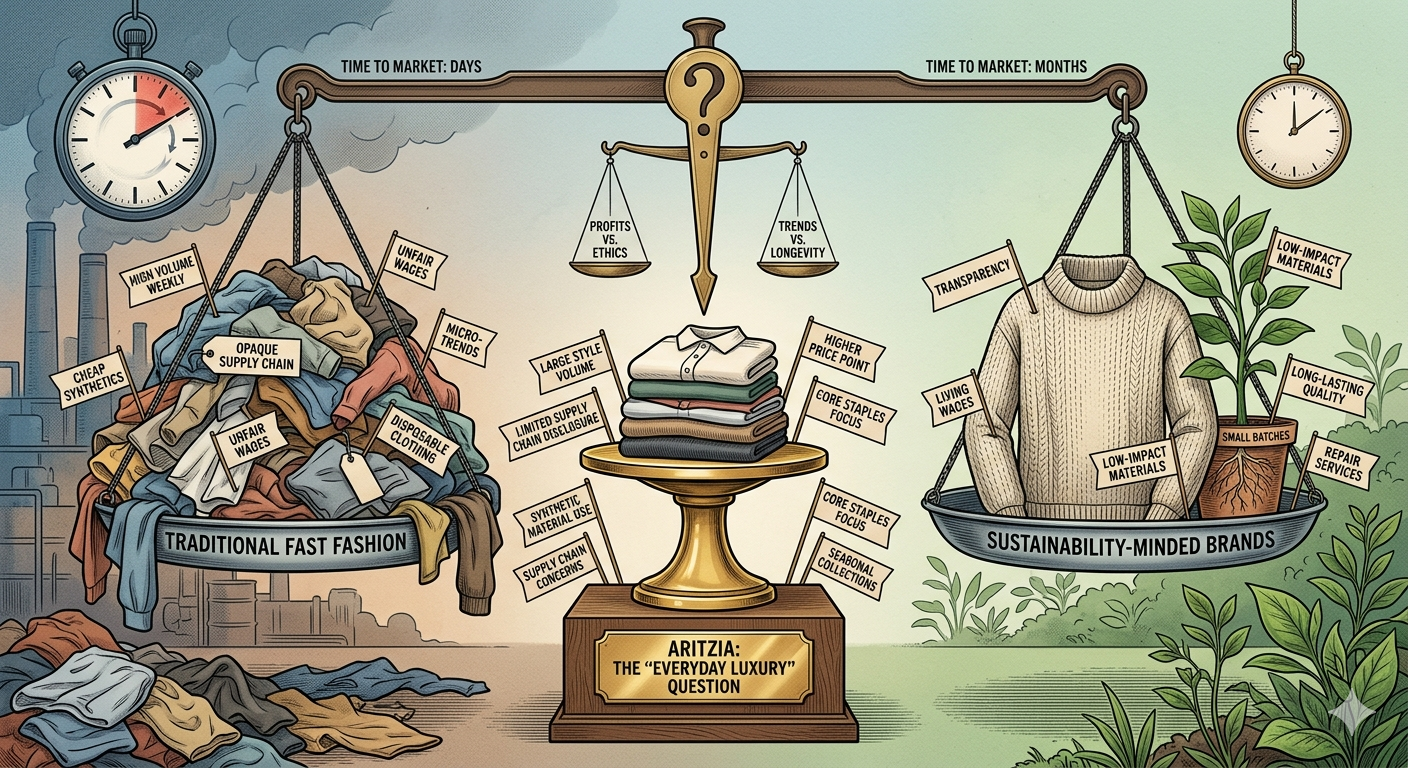
In the modern retail landscape, consumers are becoming increasingly conscious of where and how their clothes are manufactured. While ultra-fast fashion giants like Shein, Temu, and Zara frequently face backlash for environmental degradation and mass production, mid-tier and contemporary retailers are now coming under the same intense scrutiny.
Among these, the Canadian fashion powerhouse Aritzia has sparked a massive debate. Known for its viral fashion staples like the Super Puff jacket and Effortless Pant, the brand markets itself under a very specific banner: “Everyday Luxury.”
But a growing number of digital fashion auditors, sustainability platforms, and consumers are asking a critical question: Is Aritzia actually a fast fashion brand hidden behind a luxury price tag? As of 2026, this detailed analysis breaks down Aritzia’s business model, manufacturing transparency, fabric quality, and official sustainability scores.
Defining the Tiers: Where Does Aritzia Position Itself?
To evaluate whether Aritzia is fast fashion, we must look at how the company strategically defines its market position. Officially, Aritzia states that it operates in the unique white space between fast fashion and affordable luxury.
Unlike Zara (which relies on hyper-scarcity and replicating runway trends within two weeks), Aritzia relies on a vertically integrated house of “Power Brands” (including Wilfred, Babaton, TNA, and Sunday Best). This model allows them to maintain a high-end boutique experience while keeping tight control over design and distribution.
Fashion Industry Comparison Matrix
| Metric | Ultra-Fast Fashion (e.g., Shein / Zara) | Aritzia (“Everyday Luxury”) | True Luxury (e.g., Chanel / Hermès) |
| Price Point | Very Low ($10 – $50) | Mid-to-High ($60 – $400) | Extremely High ($1,000+) |
| Production Speed | Days to Weeks | Seasonal Drops (with high frequency) | Months to Years (Slow Fashion) |
| Sell-Through Strategy | Aggressive markdowns & sales | 95% Full-Price Sell-Through | Exclusivity & zero discounts |
| Primary Fabric Makeup | Cheap synthetics (Polyester) | Mix of natural fibers & synthetics | Pure luxury textiles (Silk, Cashmere) |
Why Critics Classify Aritzia as Fast Fashion
While Aritzia’s price tag and aesthetic lean toward luxury, several independent supply chain whistleblowers argue that it shares the exact same operational DNA as fast fashion brands.
1. High-Frequency Product Cycles
The technical definition of fast fashion relies on how quickly a brand introduces new inventory to encourage micro-trend consumption. Aritzia drops multiple mini-collections and colorways every single season. The rapid introduction of new styles forces consumers into a cycle of continuous purchasing.
2. Declining Material Quality
On platforms like Reddit and TikTok, long-time shoppers have pointed out a sharp price vs. quality disconnect. While older Aritzia items (pre-2019) heavily featured 100% silk, pure wool, and high-grade cashmere, modern productions rely significantly on virgin synthetics, polyester blends, and thinner fleece fabrics to cut manufacturing costs while maintaining high retail margins.
3. Overseas Mass Production
Aritzia’s garments are mass-produced through third-party supply factories globally—mainly located in China, Cambodia, Vietnam, and Bangladesh. These are the exact same manufacturing hubs utilized by low-cost fast fashion networks, triggering massive concerns regarding fair labor wages and worker protection rights.
The Sustainability Score: What Do the Watchdogs Say?
Independent environmental and ethical fashion rating platforms give Aritzia incredibly low scores, heavily contesting its sustainable marketing narrative.
- Good On You Rating: The leading ethical fashion directory rates Aritzia as “Not Good Enough” (2 out of 5). The platform cites that there is no verified public evidence that Aritzia ensures living wages across its supply chain or takes concrete steps to preserve biodiversity.
- The Commons Rating: Awards the brand an “Insufficient/Poor” rating. The primary drivers for this score include its heavy reliance on high-emissions virgin materials and the complete lack of a circular take-back or repair infrastructure to keep garments out of landfills.
- The Transparency Issue: In various global audits (such as the Fashion Transparency Index), Aritzia has scored poorly on overall supply chain traceability. Without explicit public disclosure of its factory lists and audited labor statistics, independent watchdogs cannot verify if its supplier codes of conduct are actively enforced.
The Verdict: Is Aritzia Fast Fashion?
Technically, Aritzia is not traditional fast fashion, but it cannot be classified as an ethical or sustainable brand either.
The most accurate classification for Aritzia is “Contemporary Mass-Market Retail” or “Premium Fast Fashion”. It operates on a hybrid model: it utilizes the rapid design, high-volume production, and overseas supply chains of fast fashion, but balances this with tailored boutique retail experiences, structural design longevity, and high full-price margins that prevent massive textile overproduction waste.
FAQs Section (Frequently Asked Questions)
1. Is Aritzia considered an ethical brand?
No, independent watchdogs currently rate Aritzia’s ethical standards as “Not Good Enough”. This is due to a severe lack of supply chain transparency, reliance on virgin synthetic materials, and no verified proof of paying living wages to factory workers.
2. Where are Aritzia clothes manufactured?
Aritzia designs its clothes in-house in Canada, but mass production is outsourced to global manufacturing facilities located primarily in China, Vietnam, Cambodia, and Bangladesh.
3. Why is Aritzia so expensive if it uses synthetic fabrics?
Aritzia leverages its “Everyday Luxury” brand narrative, high-touch store experiences, and influencer endorsements to command strong pricing power. While some items use organic cotton or wool, many basics now feature polyester blends despite their premium retail price.
4. What are some sustainable alternatives to Aritzia?
If you love Aritzia’s minimalist and clean silhouette aesthetic but want a brand with verified ethical practices, look into Reformation, Everlane, and Eileen Fisher. These brands provide transparent factory documentation, detailed carbon footprints, and active clothing recycling frameworks.
Conclusion
Aritzia successfully dominates the fashion market by giving consumers the feeling of purchasing luxury without charging thousands of dollars. However, as environmental transparency regulations become stricter globally, the brand will need to address its lack of supply chain traceability and heavy reliance on synthetic materials. For conscious consumers, the best way to shop Aritzia sustainably is to buy their high-quality classic silhouettes (like wool coats or tailored trousers) and avoid their rapid, trend-focused seasonal drops.