

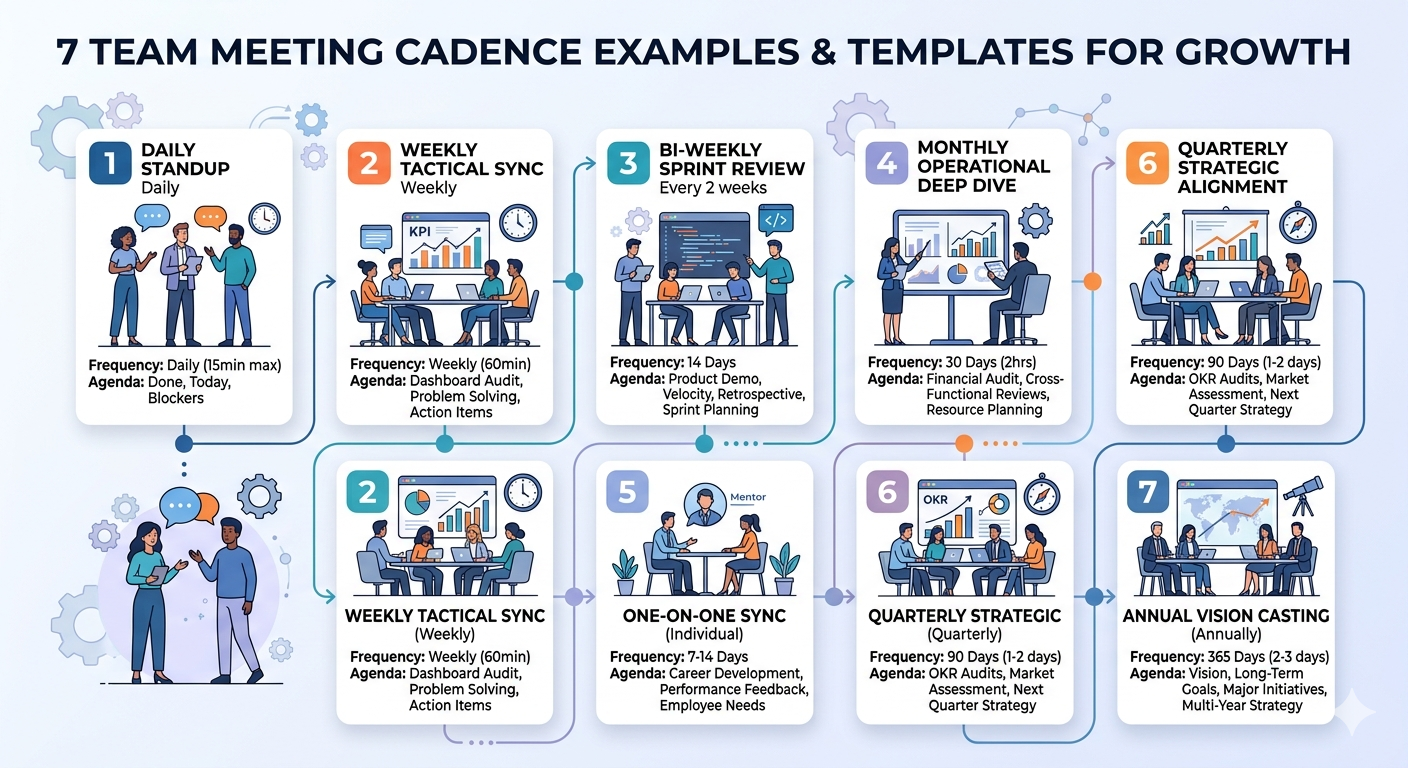
Meetings are the lifeblood of organization alignment, yet they are routinely cited as the single greatest drain on corporate productivity. When an organization scales without a intentional communication architecture, managers default to reactive, unorganized meetings that disrupt deep work and induce severe professional fatigue.
The remedy is not to stop meeting altogether; the solution is to establish a rigorous, highly structured operational schedule. By institutionalizing predefined corporate touchpoints, you build an environment where team members spend less time tracking down updates and more time executing core business strategies.
This guide breaks down seven essential communication templates, mapping out exactly how to build high-performance meeting frameworks across every operational level.
The Core Blueprint of a High-Growth Meeting Schedule
Before launching recurring calendar events, it is crucial to understand the foundational principles that separate impactful corporate alignment from empty, repetitive corporate rituals. Every highly productive meeting within a modern enterprise must satisfy three immutable parameters:
- Strict Temporal Boundaries: Meetings must begin exactly at the designated minute and conclude on or before the scheduled deadline—regardless of individual lateness. This instills an organizational culture that respects collective time.
- Uncompromising Agenda Control: If a meeting lacks a documented, pre-distributed agenda detailing the exact discussion sequence and owners, it must be automatically canceled.
- Data-Driven Focus: Conversations should avoid subjective narratives and instead center on objective operational dashboards and performance metrics.
To deeply master how these internal loops integrate with your broader commercial operations, make sure to read our macro architectural breakdown, [What is a Cadence in Business? The Ultimate Guide to Workflows], which establishes the universal rules for scaling cross-departmental operations.
7 Essential Team Meeting Frameworks and Ready-to-Use Templates
           [Annual Strategic Planning]  <- Macro Vision & Resource Deployment
                       │
         [Quarterly Strategic Alignment] <- Goal Recalibration & OKR Audits
                       │
         [Monthly Operational Deep Dive] <- Department Performance & Financial Audits
                       │
          [Weekly Tactical Synchronization] <- KPI Dashboard Review & Blocker Removal
                       │
             [Daily Operational Standup]  <- Instant Micro-Alignment & High-Velocity Fixes
1. The Daily Standup (Operational Alignment)
Designed for high-velocity environments like software development, product management, or customer success teams to unblock daily technical operations.
- Target Frequency: Every 24 Hours (Morning).
- Strict Duration: 15 Minutes maximum.
- Ideal Attendance: Immediate execution teams and project managers.
Ready-to-Use Template:
Plaintext
- [00:00 - 03:00] Critical Review: Yesterday's key completions.
- [03:00 - 08:00] Execution Focus: Today's core operational priorities.
- [08:00 - 15:00] Blocker Identification: Unveiling direct issues requiring immediate cross-functional support.
2. The Weekly Tactical Sync (Departmental Execution)
The most critical structural engine for standard business units to review weekly progress and realign on performance goals.
- Target Frequency: Every 7 Days (Typically Monday Morning).
- Strict Duration: 60 Minutes.
- Ideal Attendance: Functional department leads and execution personnel.
Ready-to-Use Template:
Plaintext
- [00:00 - 10:00] Dashboard Audit: Reviewing the central weekly KPI metrics scorecard.
- [10:00 - 25:00] Progress Tracking: Identifying variances in quarterly priorities.
- [25:00 - 50:00] Deep-Dive Problem Solving: Engineering tactical fixes for off-track targets.
- [50:00 - 60:00] Action Item Validation: Reviewing new task assignments and deadlines.
3. The Bi-Weekly Sprint Review (Product Engineering)
Essential for technical groups running structured project intervals to review working software and prioritize product backlogs.
- Target Frequency: Every 14 Days (End of Sprint Cycle).
- Strict Duration: 45 to 60 Minutes.
- Ideal Attendance: Product owners, scrum masters, developers, and QA analysts.
Ready-to-Use Template:
Plaintext
- [00:00 - 15:00] Product Demonstration: Reviewing completed, shippable features.
- [15:00 - 35:00] Velocity Review: Auditing estimated vs. actual story points delivered.
- [35:00 - 50:00] Retrospective Analysis: What worked well, and what failed in the current sprint?
- [50:00 - 60:00] Next Sprint Planning: Confirming the core objectives for the incoming sprint cycle.
4. The Monthly Operational Deep Dive (Strategic Tracking)
A mid-level meeting focused on reviewing high-level corporate data and financial metrics across distinct operational branches.
- Target Frequency: Every 30 Days (First week of a new month).
- Strict Duration: 2 Hours.
- Ideal Attendance: Department heads, directors, and executive leadership.
Ready-to-Use Template:
Plaintext
- [00:00 - 30:00] Financial Performance Audit: P&L statements, marketing burn rates, and customer acquisition costs.
- [30:00 - 75:00] Cross-Functional Reviews: Main updates from Sales, Marketing, Engineering, and Operations.
- [75:00 - 110:00] Major Initiative Analysis: Status updates on large, cross-departmental projects.
- [110:00 - 120:00] Next Month Priority Alignment: Approving adjustments to resource allocations.
5. The One-on-One Sync (Professional Mentorship)
A private, non-tactical coaching session designed to review employee engagement, career pathing, and individual feedback.
- Target Frequency: Every 7 to 14 Days.
- Strict Duration: 30 to 45 Minutes.
- Ideal Attendance: Manager and direct report.
Ready-to-Use Template:
Plaintext
- [00:00 - 15:00] Employee Agenda: Open floor for the direct report to air challenges or concerns.
- [15:00 - 30:00] Career Development: Long-term skill tracking and personal goal evaluation.
- [30:00 - 45:00] Professional Feedback Loop: Mutual feedback on manager-employee dynamics.
6. The Quarterly Strategic Alignment (Macro Audits)
A wide-ranging corporate alignment event focused on checking Objectives and Key Results (OKRs) against actual market realities.
- Target Frequency: Every 90 Days.
- Strict Duration: 1 to 2 Full Days.
- Ideal Attendance: Executive leadership, founders, and division vice presidents.
Ready-to-Use Template:
Plaintext
- Section 1: Previous Quarter Retrospective: Complete post-mortem on missed and achieved OKRs.
- Section 2: Competitive Market Assessment: Reviewing shifting trends and competitive moves.
- Section 3: Next Quarter Strategy: Engineering new company-wide OKRs and matching department budgets.
7. The Annual Vision Casting (Long-Term Strategy)
A massive, high-level meeting dedicated to establishing the primary macro goals and multi-year financial targets of the enterprise.
- Target Frequency: Every 365 Days.
- Strict Duration: 2 to 3 Business Days.
- Ideal Attendance: C-suite executives, founders, board members, and advisory partners.
Ready-to-Use Template:
Plaintext
- Day 1 Focus: Multi-year strategic progress review and macro financial analysis.
- Day 2 Focus: Designing 12-month organizational goals and big strategic initiatives.
- Day 3 Focus: Organizational redesign, market expansion planning, and final budget approval.
Step-by-Step Implementation: How to Enforce Your New Communication Model
Transitioning a legacy company or an expanding digital portfolio to this model requires clear operational guidelines:
- Step 1: Perform a Calendar Cleanup Audit: Ruthlessly delete legacy, ad-hoc, or low-value recurring meetings before establishing this new model.
- Step 2: Assign Strict Meeting Owners: Every single calendar invite must have a clear owner who is personally responsible for creating and distributing the agenda, tracking times, and capturing action steps.
- Step 3: Create Asynchronous Alternatives: If a meeting’s sole purpose is reading off static information that could easily be shared via an internal dashboard or tool, cancel it instantly. Shift informational updates to asynchronous tools to preserve valuable focus time.
Frequently Asked Questions (FAQs)
What is the most important team meeting cadence for a fast-growing startup?
The Weekly Tactical Sync is the most important framework for early and growth-stage companies. It acts as the operational bridge between high-level monthly strategy and daily execution, ensuring that roadblocks are addressed before causing major delays.
How do you deal with a team member who is consistently late to a scheduled meeting?
Enforce a hard “start-on-time” rule. If a meeting starts at 9:00 AM, the owner must lock the virtual link or close the physical door at 9:00 AM sharp. Beginning meetings without waiting for late individuals builds a reliable, prompt corporate culture.
Should daily standups be used to solve complex technical problems?
No. The daily standup is strictly for identifying blockers, not solving them. If a complex technical challenge arises, the relevant individuals should log it as a blocker and schedule a separate, targeted breakout session after the standup concludes.
How many recurring meetings should a standard employee have per week?
An execution-focused employee should spend no more than 10% to 15% of their total weekly hours in alignment meetings. Over-scheduling teams leads to cognitive fatigue, lower operational quality, and delayed delivery across core priorities.
To fully understand how these schedules connect with your overall business strategy, read our main guide on What is a Cadence in Business